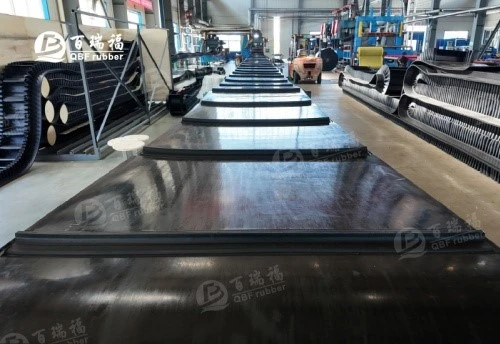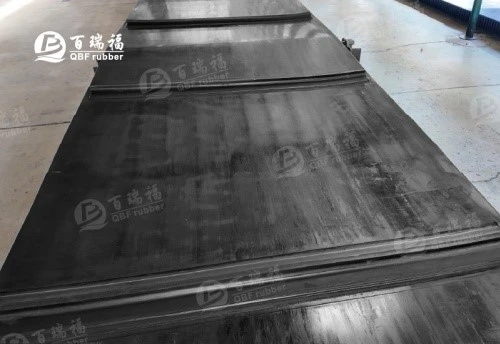

A batch of custom cleated conveyor belts has been on the vulcanizing press at our belt shop this week, built for a steep aggregate incline at a quarry customer. The photo above shows the belts laid out after cure.
The work order calls for a wide EP carcass, straight transverse cleats on a regular pitch and a heavy abrasion-resistant top cover. The customer is moving crushed stone of mixed lump size and had been losing material on a smooth belt before the upgrade.

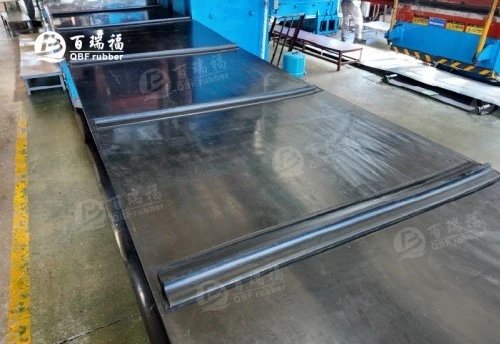
Cleats cured into the cover, not glued on
Each cleat goes into the press with the belt. The cover is buffed and cleaned where the cleat sits, bonding agent goes on both faces, and heat and pressure do the rest. What comes out is one piece of rubber, with the cleat cross-linked into the cover rather than resting on top of it.
The difference shows up in service. A glued cleat holds until heat and moisture reach the adhesive, then lifts from one corner and peels. A returned glued belt we tested recently had lost several cleats while the cover around them was still healthy. On this batch, the pull test tears through the belt carcass instead of along the cleat base, which is exactly the result we want.
How the cleat height was set
Cleat height follows the largest lump in the load. The cleat has to stand deeper than the biggest rock so the stone cannot roll over it, and shallow enough that it clears the head pulley on discharge. On this order the cleat sits roughly one step above the top lump size, which is the margin we normally work to.
Pitch is the other half of the pocket. Wide spacing lets stone roll between cleats on a steep incline; tight spacing turns the belt into a row of buckets that carries material back on the return run. The pitch here sits inside that window, wide enough to empty cleanly.
Straight bar rather than chevron, because the stone is screened and fairly uniform and full-width cleats clear the head pulley without leaving residue.
Where this belt type runs
Custom cleated conveyor belts turn up wherever the route is steep or the floor space is short: quarry and mine inclines, cement clinker and raw meal, steel sinter and coke, port unloaders and transfer towers, sand and gravel plants, fertilizer and chemical granules, recycling lines, tunneling muck, and food or grain elevators.
Cleats alone hold an incline to roughly 35–40°, depending on the material. Past that, the same order would move to a corrugated sidewall construction. Cleat heights across our range run from 20 mm for fine powder to 100 mm for ore above 80 mm lump, always capped at about one third of the belt width so the belt still tracks on the return side.