



Pipe Conveyor Belt
Your Professional Pipe Conveyor Belt Supplier
Qingdao Best Friend Rubber & Plastic Co., Ltd. (Short as QBF) has been involved in the design, manufacturing, engineering, and service of bulk conveying systems. They focus on the production, research and development of European standard long-life sidewall conveyor belts and other special rubber conveyor belts. Our products include sidewall conveyor belts, specialized conveyor belts, conveyor belt accessories, a cold bonding system, and pulley lagging.
Why Choose Us?
Rich Experience
Our management team has over 20 years of experience in the material handling industry.
Broad Market
QBF products are exported to more than 50 countries and regions around the world. They have replaced 90% of domestic imports of conveyor belts.
Wide Range of Applications
QBF products have been successfully applied in the mining, metallurgy, power plants, chemicals, tunneling, harbors, and other industries, providing innovative and efficient solutions for bulk material transportation.
Leading Service
QBF can provide full life cycle services, including pre-sales, sales, and after-sales services. QBF can always provide customers with technical diagnosis, conveyor system design, installation, engineering maintenance, spare parts, dust removal systems, and all kinds of conveyor belts as well.
Definition of Pipe Conveyor Belt
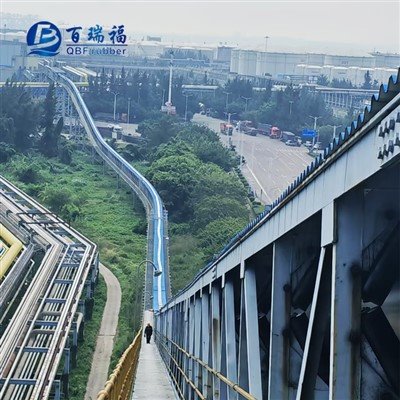
Pipe conveyor belts, or tube conveyor belts, are used for enclosed material transport. After loading in the conventionally troughed belt, the belt is formed into a pipe shape with overlapped belt edges. The material is then completely enclosed by the belt. A key advantage of closed pipe conveyor belts is their highly flexible design, which means they can be built to follow the contours of any landscape.
What are Advantages of Pipe Conveyor Belt?
Close Transport of Bulk Materials
It does not spill or leak during the conveying process, and also prevents the mixing of materials outside the pipe. Therefore, the pollution-free green transportation is realized, the environment is purified, and the belt conveyor corridor or the sealing cover is not required to be installed, thereby reducing the cost of infrastructure and the equipment cost.
Curved Arrangement of Conveying Lines in Space
It can realize the turning in the vertical plane and the horizontal plane, can bypass various obstacles, cross roads, railways, rivers and various buildings, etc. without intermediate transfer, so the wiring layout is simple, the failure rate is small, and the maintenance amount less.
The Conveyor Machine Width is Small
Due to the use of a circular section to transport the material, the belt belt machine has a larger effective conveying area at a lower width. Under the same conditions, the width direction can be reduced to 1/3 of the original. This reduces the space requirement for civil construction. , reducing steel consumption, reducing costs and working hours.
Can Increase the Conveying Inclination
The material is wrapped around the conveyor belt, and the conveying pressure is increased by the side pressure and the friction between the material and the inner surface of the conveyor belt. The larger the filling coefficient, the larger the inclination angle can be up to 30°.
Two-Way Conveying of Materials
Since the belt belt machine adopts a closed tubular structure in both the load-bearing section and the return section, the return section can still transport the material.
What are Features of Pipe Conveyor Belt?
Spillage-Free
They are ideal for transporting materials such as municipal waste, ash, limestone or shredded tires, which might otherwise present an environmental hazard. Reducing the environmental impact and increasing circularity of these materials can contribute, not only to your bottom line, but to your sustainability goals.
Material Properties
Made of high-tensile steel cords or textile reinforcements depending on the application, and available in various cover grades. Your choice of cover grade depends on the intended application. Note that the working life of the belt is also determined by the application.
Enclosed transport of hot material does not allow heat exchange to the atmosphere, therefore material temperatures must be lower than in conventional installations.
Special Features
Pipe Conveyor Belt enables a more flexible design than traditional types of conveyor belts. Various configurations (convex and concave curves) help reduce the number of transfer points leading to smooth treatment of the material and a reduction in installation and operating costs.
This method of conveying contributes to safe, clean and spillage-free material transport, which helps protect the environment and keep maintenance costs low. It also protects your material from external conditions such as snow, rain, wind and dust.
Applications of Pipe Conveyor Belt
Boiler Related
Conveying coal/coke/ash.
Ironmaking-Related
Conveying water slag/desilicant/pulverized coal pellets.
Paper Manufacturing
Chip transportation.
Cement-Related
Product transfer.
Chemical
Fertilizer/chemical transfer.
Foods
Raw materials for oil and flour milling.
Feed-Related
Raw material/product transportation.
Other
Transportation of various powders/rounds (pellets).
Components of Pipe Conveyor Belt
Loading or Tail End Section
On the carrying side in tail end, skirts are provided to prevent spillage of the loaded material. During belt moving in the direction of travel, the belt is troughed via transition idlers. From the loading point, the conveyor belt is further gradually to the full pipe form. Adjustable troughing idlers along the section guide the belt into the formation of the pipe shape. The overlap in belt is at the top of the pipe formation and finger rolls are used to guide the belt in pipe formation.
Proper alignment of tail pulley, idlers and the centralized loading of the conveyor are all important to correct formation of pipe and positioning of belt overlap.
On the return side in tail end, the tubular form of belt is gradually opened from the point where the belt exits at the last idler support panel to the tail pulley. An adjustable return belt scrapper is provided prior to the tail pulley to remove any residual material from the belt before it passes through the tail pulley.
Intermediate Section
A position in between the point where the belt is formed into the tube and where the tube is reopened at the discharge point is termed the intermediate section of the pipe conveyor.
Once the tube shape is formed, this form is maintained on both the carrying and return side of the conveyor by means of idlers. These idler panels are spaced at a uniform interval along the conveyor length.
Head or Discharge Section
At head or discharge area, the pipe is gradually opened from the point of the last idler panel to the head pulley. The belt is supported throughout this transition section by a series of idlers. In this way the pipe conveyor is opened and the material being conveyed remains in the center of the opened belt.
The head pulley is at point of the discharge of the pipe conveyor and the entire conveyed product is discharged through the discharge chute onto the subsequent conveyors or equipment.
The idlers supported the belt through the transition section at head end are similar to those at the loading area. The idler frames allow the idlers to be adjusted.
Drive Assembly
It is used to drive the belt conveyor. It consists of:
Motor
Gearbox
Coupling
Brake
Safety switches like zero speed switch, pull cord switches, Belt sway switches and chute block switches are installed along the conveyor for safely operation of belt conveyor.
Belt Tension
Inconsistent belt tension can lead to belt misalignment and the intermittent popping out of the tucked-in side. Ensure that the conveyor's tensioning system is properly adjusted to maintain even tension along the entire belt.
Belt Tracking System
Pipe conveyors often have specialized tracking systems to keep the belt centered within the pipe. Check the tracking system's components, such as idlers, pulleys, and guide rollers, for wear, damage, or misalignment. Proper alignment of these components is crucial to prevent belt drift.
Material Load
Uneven material loading or surges in the conveyor can cause the belt to shift. Ensure that the material is evenly distributed across the belt and that the conveyor is operating within its designed capacity.
Pipe Diameter and Transition Zones
The pipe diameter and transition zones where the conveyor enters or exits the pipe can affect belt stability. Ensure that the design and dimensions of the pipe and transition zones are appropriate for the material and conveyor speed.
Belt Condition
Inspect the condition of the conveyor belt for signs of damage, wear, or material buildup that could affect its stability. Replace or repair damaged sections of the belt as needed.
Conveyor Speed
Excessive conveyor speed or sudden changes in speed can lead to belt instability. Ensure that the conveyor is operating at the appropriate speed for the material and system design.
Conveyor Alignment
Check the overall alignment of the conveyor system, including the frame, idlers, and pulleys. Misalignment can cause the belt to wander and pop out.
Material Properties
Consider the properties of the conveyed material, such as its size, shape, and abrasiveness. Abrasive materials or irregularly shaped particles can impact belt stability.
Belt Lacing and Splicing
Inspect the quality of belt lacing or splicing. Poorly executed splicing can lead to weak points in the belt where popping out may occur.
Maintenance and Lubrication
Regular maintenance of the conveyor components, including lubrication of moving parts, can prevent issues that contribute to belt misalignment.
Operating Conditions
External factors, such as temperature, humidity, and environmental conditions, can influence belt behavior. Ensure that the conveyor system is designed and operated with these factors in mind.
Our Factory
QBF is one of the leading R&D company of Heavy-duty Cleat, PE board leak-proof structure, sticky material easy-to-clean formula and personalized color glue in China. Largest Sidewall conveyor belt single production enterprise in Asia.
QBF holds leading technology and market cases in the fields of lifting height, large Conveying capacity, steep incline lifting, single length, anti-stick and other products.


Our Certificate
QBF also follow global standards with certificate. QBF will be your solution partner in sidewall belting and special conveyor belt, accessories,etc.


Contact Us
+8613969729233
Frequently Asked Questions
Q: How is the Pipe Conveyor Belt designed?
A distinct design feature of the Pipe Conveyor Belt is the round shape of the belt. There are two design variants: oval and circular. Each shape has its unique advantages. The oval shape seals the overlap of the belt a little better, because the angle of the overlap is flatter. On straight sections and across long distances the oval shape performs well – here the belt runs steady with little twisting or deviation. This is also due to the aerodynamics, there is less surface for wind resistance. On the other hand, the circular or round tube shape requires less reinforcement, and the cable construction has greater stability. The service life of the lower rollers are also extended, as they do not have to carry as much weight and endure less wear and tear as a result.
Whether short distances for alternative fuels, cement, or clinker or kilometre-long transport of ores, limestone and gravel – our technical expertise will help ensure proper planning at the beginning of your project. Our knowledge of horizontal, inclined and ascending routing and proprietary calculation programs are what make the realisation of big projects possible in the first place. With extensive feasibility studies and elaborate simulations of loading conditions and throughput rates, we develop the right system solution for you with the appropriate belt width and drive power for conveying your goods.
Q: What are the advantages of Pipe Conveyor Belt over traditional rubber belts?
• Horizontal and vertical curves with reduced bending radius
• Little space requirement by compact plant design
• Reduced spillage of materials loaded from the belt
• Dust free transportation
• Low maintenance
The Pipe Conveyors show several advantages if compared with conventional conveyor: the belt is rolled, after the loading point, into a pipe shape, containing the material inside with a very limited envirnment impact.
The Pipe Conveyor can negotiate much tighter curves than a flat belt as well as it can negotiate steep inclines and this will facilitate complex routing requiring less space than a conventional conveyor.
This advantage of being able to run tight curves is an essential aspect, since it can eliminate transfer points that are normally necessary when there is a relative sharp change in belt direction.
A Pipe Conveyor can transport the same volume of material as a conventional conveyor belt which is typically approx. double the width of the Pipe Conveyor, this is an important factor where space is limited, such as inside a tunnel.
The environmental regulations introduced in the last years require the industries to redraw the use of the plants for the transportation of dusty materials; the tubular belts plants are the most suitable for those materials handling where a special care to the environmental protection is needed.
Hence, it becomes evident that Pipe Conveyor Belt can be considered an environmental friendly products since they are used to prevent dust or material spillage to avoid polluting the surrounding areas. Nonetheless, some products affected by the presence of humidity, such as cement, meet in the tubular conveyor belt system the right technology for their transport in open areas such as loading and unloading wharfs.
At the very beginning, you have been informed that pipe conveyors are perhaps SIG most iconic products for cement industry where these tubular shape items can guarantee astonishing performances.
What can be surely claimed is that Pipe Conveyor Belts give the maximum of their potential in the fields of: cement factories, power plants, ports and steel making plants.
Q: What is Pipe Conveyor Belt?
In a Pipe Conveyor system the belt runs flat over the head, tail and snub pulleys. The belt is troughed by idlers at the feeding point. Once the belt is loaded, it is formed into a pipe by overlapping its edges. At the discharge end the belt opens out to a troughed belt running flat over the pulleys. Material can be transported on the return belt.Intermediate loading can be provided at any point by opening and closing the belt at the required feed point.Pipe conveyors are an environmental friendly solution for conveying bulk material with zero spillage and ability to cover terrain difficult to negotiate by conventional conveyors.
Advantages
Unlimited capability for direct transfer of materials between two points which is not possible with conventional means.
Enclosed, clean and environment friendly transportation eliminating all spillage, scattering and return dropping of materials.
Elimination of transfer points and non-exposure to atmosphere results in retention of material properties while conveying.
Curvature possible in both horizontal and vertical planes associated with steeper angle of inclination.
Possibility of transporting second material through the return side pipe of the system, thereby reducing capital and operating cost.
Overall savings in space requirement, structural and foundation cost, thereby making the investment decisions easier.
Even a horizontal angle of 90 degree possible with the current technology.
Q: What solutions does the Pipe Conveyor Belt provide to the problems facing the industry?
Spillage free transportation of material is obtained due to the enclosed belt.
Material build-up on idlers is reduced, decreasing maintenance, as no material is spilled during transit.
Pipe conveyors fit into narrow areas and save space in congested areas. This is possible due to a circular belt profile, allowing the gantry width to be reduced.
Can negotiate tight horizontal and vertical curves because the material is enclosed within the pipe and cross belt slip is reduced by the idler configuration.
Greater rate of elevation is obtained due to the increased contact between belt and material.
Has better belt edge damage control, due to improved belt training.
Weather resistance to wind and rain is improved as the material is enclosed, therefore gantry does not require covers.
Ecologically/environmentally friendly as it is able to pass around sensitive areas and negotiate remote terrain.
Q: What are the characteristics and applications of Pipe Conveyor Belt?
FEATURES
Prevents transport materials from flying, spilling or mixing with foreign substances as transported in a sealed pipe.
Consumes less energy than ordinary conveyor lines.
3-dimension layouts are available with openings at top, bottom, left or right.
Allows for maximum 30 degree incline transport, much steeper than ordinary conveyor belts.
Occupies minimum installation space.
Generates much less noise than ordinary conveyor lines.
APLICATION GROUPS
Cement and concrete plants.
REA - or gypsum plants.
Lime industry.
Tunnel construction.
Conveying dusty and fine-grained material.
Material of lower density and environmentally hazardous material
Silo conveyors.
Conveyors crossing roads (bridge conveyors).
Heating stations, power stations, garbage incinerating plants.
Q: Why is Pipe Conveyor Belt popular?
Pipe conveyors are similar to a conventional belt conveyor at the material receiving area and discharge area. Thereafter the flat belt is slowly shaped to trough belt through transition and carrying idlers. At the end of loading zone, the conveyor belt gradually takes on a pipe formation with the help of variable off set rollers, finger rollers and pipe forming idlers.
The bottom three rollers at the carrying side of a Pipe Conveyor support the belt and material load whereas the top three rollers maintain the belt in its pipe shape. At the horizontal and vertical curved sections, rollers surrounding the belt support the load depending on the direction of the resultant force. The same applies to the bottom or return belt side of the pipe conveyor which may be utilized to transport a second material, thereby reducing capital and operating cost.
Development of suitable high resilient flexible belting has acted as a catalyst for the growth and popularity of pipe conveyor installations for several industries.
Pipe Conveyer's advantages over conventional conveyors:
Enclosed, clean and environment friendly transportation eliminating spillage, scattering and return dropping of materials.
Non-exposure to atmosphere resulting in retention of material properties.
Curvature possible in both horizontal and vertical planes associated with steeper angle of inclination.
Option of transporting second material through the return side pipe of the system.
Overall savings in space requirement, structural and foundation cost.
Q: What are the technical features of Pipe Conveyor Belt?
The sealing is good at the overlap edge, fatigue resistance, abrasion resistance, with stable bearing capacity.
As enclosed conveying, the materials won’t float in the sky or fall, and will not affect the environment, especially for the fine materials such as powder or paste.
To protect the material from wind, rain, snow and some other environment.
Compared with traditional flat conveyor belts, pipe conveyor belts consume less energy during transportation. This is because the tubular structure can reduce the resistance and friction of the material and reduce the energy required for transportation.
Due to the unique structure and applications of pipe conveyors, they require higher technical specifications compared to conventional conveyor belts. For example, the requirements for EP (ethylene propylene) and NN (nylon) fabrics include enhanced flexibility in the latitudinal direction, thicker skim rubber, and stronger adhesion between fabrics and cover. Consequently, the production of pipe conveyors imposes greater demands on conveyor belt manufacturers’ capabilities, necessitating them to possess stringent production management and quality testing capabilities.
Q: What industries can Pipe Conveyor Belt be used in?
Pipe Conveyor Belt is using for conveying materials required environment protecting and three-dimensional bend conveying in coal, mine, port, electric power, metallurgy, architecture, food industry. During hermetic conveying, the materials do not fly upwards and fall off, do not influence by environment, can be bend, big obliquity, out and home conveyed.
Q: Why choose our Pipe Conveyor Belt?
Its application is versatile to carry all type of material in all kinds of industry.
Advantages of pipe conveyor over conventional conveyor are
A flat belt turns in to a shape of pipe and carries material.
Pipe shape gives protection to material being handled against weather such as wind and rain.
Reduction in transfer points.
Reduces Spillage of Costly Material during transportation from one point to another.
Compact design results in to space saving, works in any terrain, permits steep inclination angle and sharp bend.
Special Features about our PIPE CONVEYOR BELTS are as under:
Special pipe conveyor fabric is used to keep tension on the rollers & preventing collapsing of pipe.
Special fabric construction is given to reduce stress on the carcass during running & pipe formation.
Supplied in longer length to reduce no of joints in the pipe conveyor.
For high temp grade application, special top cover layer is given to sustain heat trapped inside the pipe
Special bottom cover is given to withstand the impact & rubbing from any rollers.
Q: How does the Pipe Conveyor Belt operate?
The correct alignment / training of the belt must be checked for operation under no-load, partial load and full load conditions. For the initial alignment check i.e. for the initial new belt and for subsequent replacement belts, the conveyor must be started only once all cheeks have been completed as per the Erection Cheek Procedures. The conveyor is then started without load, with suitable monitoring by personnel along the full length of the conveyor.
Once the conveyor is started, the belt overlap must be observed with reference to the rest of the structure. Also the alignment of the belt at the tail and head end must be monitored at start-up and should the 'overlap' move clockwise or anticlockwise in the structure beyond the 20 degrees indicated above, the belt requires training.
Training of the belt should preferably be performed by one individual only. This ensures that the there is no duplication of adjustment to the idlers, especially in this instance considering the length of this conveyor. In addition, training of the betting should commence at the tail-end of the conveyor beginning with the tail pulley, loading section, etc. and progressing along the carrying-strand belt. Once at the head-end, training follows the belt line through the drives, take-up and back to the tail pulley via the return-strand.
To train the belt, each of the pipe conveyors' idler panels are fitted with two training idlers, on the carrying and return strands respectively. These idlers are usually the bottom idlers of each set of six idlers, and are mounted on a bracket which has slotted adjustment holes. Where the conveyor negotiates a horizontal curve, the training idlers are usually off-set to the inside of the curve radius.
To adjust the belt training, first establish whether the belt is required to rotate either clockwise or anti-clockwise for the 'overlap' to be at the top (carrying-side) or bottom (return-side) of the idler set. Secondly, establish which idlers on which of the idler panels require adjustment. To do this, the source of the misalignment must be found i.e. where the belt begins to misalign, and these idlers must be adjusted.
The bolts on the identified adjusting idler brackets must then be loosened slightly, to enable the bracket to be turned.
To align the belt, the idler bracket must be turned in the correct direction. The effect which this training has on the alignment of the belt is identical to that experienced on conventional conveyors.
Care must be taken to prevent excessive adjustment -of the training idlers. Adjustments must be made in small increments, to three or four adjacent training idlers at one time followed by observation for approximately 5 minutes, to allow the adjustment to take effect before further adjustments are made.
Where idlers are adjusted, the panels should be marked for reference purposes.
Once the belt is running true in the panels, partial load should be conveyed, followed by full load testing. All training idler brackets must be re-tightened once training of the belt is complete.
If it is found that by adjusting a series of training idlers, the belt alignment is not improved, then the adjusted idlers must be re-set to their original positions before proceeding to the next series of panels to make further adjustments. In this way the belt training procedure is conducted in a logical, systematic way.
Q: What factors can cause Pipe Conveyor Belt?
If your conveyor frame is crooked or slanted, it could be misguiding your belt. Check your framework from all angles to ensure the frame is level and square.
Snub rollers
These rollers create more tension in your belt and make contact with every pulley in the system. Tenison is crucial to tracking, so your snub rollers should align with your frame and apply enough tension to the belt.
Belt cutting
Conveyor belts can be cut incorrectly during manufacturing, making them crooked. No matter how well the rest of your system runs, a crooked belt will cause tracking errors.
Cleanliness
Buildup on the belt and pulleys can cause the belt to sway one way or another. Make sure all parts of your conveyor are clean to ensure a smooth run and prevent failure.
False crowns
Conveyor belts move a variety of items, and sometimes the material can snag or get stuck on a pulley. You can find crowns on the center of your end pulleys that distribute force to each side of the belt and help it stay on track. If a piece of debris gets lodged in another pulley, it can create a fake crown and redistribute weight where you don’t need it. Check to see if your pulleys are clear of debris to avoid this.