


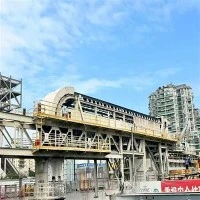


Sidewall Conveyor Belt
Sidewall Conveyor Belt
The Sidewall Conveyor Belt is a type of conveyor belt that has sidewalls set on both sides of the base material, and horizontal partitions are installed on the base material to form a "trough-like" structure. This conveyor belt can continuously transport materials within a large inclination range of 0° to 90°, saving space and reducing investment costs.


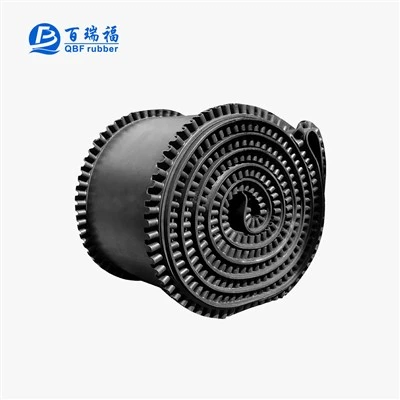


What are Advantages of Sidewall Conveyor Belt?
Practically Zero Spillage
Once the material is loaded onto the belt it is efficiently contained between the sidewalls and is prevented by the cross cleat from falling back. As the belt travels along the conveying line it retains the load within its own ‘side skirts’, eliminating spillage, but more importantly, as the sidewalls actually form part of the belt there is none of the wear normally associated with side skirts. The smooth transition when changing angle also ensures the material remains within the belt’s effective carrying area.
Space Saving
In areas where land is at a premium, i.e. dockside, or within existing plant where space is a problem, SIDEWALL CONVEYOR BELTS provides the ideal solution. With the ability to convey material at angles up to 90 deg. the required ground space is minimal.
Minimum Maintenance - Long Belt
In cost comparisons between mechanical elevators and Sidewall Conveyor Belt systems it has been proven that the Sidewall Conveyor Belt has considerable advantages. The belt itself requires no maintenance and the reduced number of moving parts plus simple conveyor construction virtually eliminates costly downtime.
Wide Range of Materials can be Handled
With the extensive range of belt sizes available, the SIDEWALL CONVEYOR BELT is capable of handling almost all materials: large lumps, free flowing, delicate or fragile substances, highly abrasive material, light weight or heavy loads. Our application engineers have the experience and a thorough working knowledge to specify the system to suit your needs.
Low Power Requirement, Quiet Smooth Running
A clear advantage of using an SIDEWALL CONVEYOR BELT system is the low power required to move the loaded belt. Because the system can elevate at steep angles (up to 90 deg.), centre distances tend to be small and even in high lift applications power required to elevate is considerably less than in other systems. As the belt is running on rotating idlers, the low resistance results in a quiet system, an advantage when operating in close proximity to personnel. Where environmental factors need to be considered, the system can be totally enclosed.
What are Features of Sidewall Conveyor Belt?
Low Investment Cost
Large-angle or vertical conveying can be realized, thereby reducing equipment and construction costs. This ultimately leads to lower total investment costs.
01
Reduced Leakage
The unique corrugated sidewall structure can effectively reduce material leakage and improve the working environment.
02
Reduced Installation Space
Compared to conventional belt conveyors, large-angle or vertical conveying reduces the length requirements to reach the design height. This, in turn, reduces the necessary installation space.
03
Flexible Layout
Sidewall belt conveyors can be combined with other conveying equipment to meet complex conveying requirements in industrial production, including horizontal, inclined, or vertical applications.
04
Low Energy Consumption
Large-angle or vertical conveying can significantly reduce the number of rollers and the length of the belt. This reduction minimizes roller and belt resistance, resulting in efficient energy consumption.
05
Uses of Sidewall Conveyor Belt
Bulk Material Handling
Bulk conveyor belts are used to move a wide variety of products and raw materials, including sugar, oats, cereal, fruit, flour, screws, nut fasteners, and food nuts. They quickly and efficiently load and unload cement, sand, and gravel. In mining, coal, minerals, rocks, and stones are moved from open and closed pit mining operations. The varying lengths of conveyor belts make it possible to remove minerals and refuse.
Ship Loading and Unloading
Mobility is a crucial factor regarding the loading and unloading of ships. In the loading process, a belt conveying system unloads trucks and moves materials into the hold of a ship. For unloading, the process is reversed, and materials are moved from the ship and conveyed to trucks. Due to the unique nature of shipping and the different types of ships, loading and unloading belt conveyors are able to adjust to the height of the ship by telescoping.
Line Automated Assembly
Assembly operations have a series of conveyors that are custom-designed to fit the needs of the operation. As more and more assembly operations are using robotics and automated processes, belt conveying systems are being rapidly developed to meet the many computerized innovations and operational demands.
The varieties of belt conveyors used for automated assembly lines include chain, slider, hinged, plastic belt, and pallet. The increasing demand for rapid and efficient material movement has necessitated the creation of new and unique belt conveyor configurations.
Mining Industry
Conveyors are used in the mining industry to transport bulk materials such as coal, ore, and minerals. They are commonly employed to transport materials from underground mines to the surface.
Agriculture
In agriculture, conveyors are used to transport grain, seeds, and other agricultural products. They can facilitate the movement of materials from storage silos to processing facilities or from fields to warehouses.
Construction
Conveyors are utilized in the construction industry for transporting materials such as sand, gravel, and concrete. They are often employed to transport materials to elevated locations, such as during the construction of tall buildings.
Manufacturing
In manufacturing, conveyors play a crucial role in transporting materials during production. They can facilitate the movement of raw materials, finished products, and scrap throughout the production process.
Recycling
In the recycling industry, conveyors are used to transport materials such as plastic, paper, and metal. They can facilitate the movement of materials from sorting facilities to processing facilities or from recycling centers to warehouses.
The Considerations for Buying
Product or Material
Knowing the particular product or material that will be transported is essential in determining the best belt system for the job at hand. The specific needs of your product will help you choose whether you need a belt system with an incline, with cleats or numbs, or whether it will need to be resistant to extreme temperatures.
Application
The style of belt used to transport goods from point A to point B will look quite different than a conveyor that’s used for indexing, positioning, or specialty process. You may want to consider a step above the basic belt for timed or specialty procedures.
Environmental Factors
Lastly, when choosing a corrugated belt conveyor, think about where it will be in use. Will it be in a temperature-controlled warehouse? Or will it be outdoors or in extreme temperatures? Some belts may be better equipped to handle adverse climates than others.
Why Choose Us?
Rich Experience
Our management team has over 20 years of experience in the material handling industry.
Broad Market
QBF products are exported to more than 50 countries and regions around the world. They have replaced 90% of domestic imports of conveyor belts.
Wide Range of Applications
QBF products have been successfully applied in the mining, metallurgy, power plants, chemicals, tunneling, harbors, and other industries, providing innovative and efficient solutions for bulk material transportation.
Leading Service
QBF can provide full life cycle services, including pre-sales, sales, and after-sales services. QBF can always provide customers with technical diagnosis, conveyor system design, installation, engineering maintenance, spare parts, dust removal systems, and all kinds of conveyor belts as well.


Our Certificate
QBF also follow global standards with certificate. QBF will be your solution partner in sidewall belting and special conveyor belt, accessories,etc.


Frequently Asked Questions
Q: Could I have a sample or a trial order free?
Q: What's the delivery term?
Q: Is QBF a manufacturer of a trading company?
Q: What are the characteristics of Sidewall Conveyor Belt?
Increase the transporting capacity to 4 times compared to the standard conveyor belt.
Save installation space due to the possibility of increasing the angle of inclination up to 90。
Small pulley diameters may be used, without the need for skirt boards. Facility costs are reduced with flat rollers.
Q: What are the technical details of Sidewall Conveyor Belt?
Sidewalls that are mounted flush on the side of the base belt without cleats (smooth top). Typically used on horizontal conveyor configurations or minimal angles (no curve up or nose overs).
The sidewalls mounted flush the the sides but with cleats between the sidewalls. This allows for moving materials at steep straight inclines (no curve up or nose overs).
The most common and widely adapted configuration is having the sidewalls slightly recessed from the belt edge to allow for inclines (with curve ups and nose overs).
Please note there should be a minimum for recess of the side (10% of the overall base belt width plus the side wall height)
Belt Width
The conveyor belt width should typically be 4 times great than the side wall height to remove the risk of "top-heavy" loading.
Face Width or Effective Belt Width
The effective width, or the lateral distance between the sidewalls, is recommended to be at least two times the largest lump size to prevent possible product bridging or entrapment.
Cleat Spacing
The center to center dimension of the pusher or cleat is recommended to be minimum of 2x the largest piece of material. This will remove the ability to have material bridge or get stuck. Its important to make sure the cleats match the inside wall of the corrugated area of the belt. This will help remove the risk of material getting stuck between the cleat and the side wall.
Cleat Height
It's important to keep your cleat height at a minimum of a 1/2" lower than the side wall height to remove the risk for jamming or interference around external chutes on the frame of the conveyor.
This also removes the risk of a cleat continually hitting the return idlers and eventually damaging the cleats on belts 24” wide or less.
Make sure the cleat height is a minimum height of 75% of the largest material height. For instance if the max height of your material is 4" the minimum cleat is 3". If the incline angle of the conveyor is at or exceeding 75 degrees, the cleats must have a minimum height of 150% of the largest item height in your material stream.
Q: What is Sidewall Conveyor Belt?
Corrugated sidewall conveyor belts are tailor-made products. Depending on the clients’ request, sidewalls and cleats can be reinforced with diagonal fabric and bolted together. This fabric layer provides an excellent tear resistance while simultaneously allows the sidewall’s flexibility. The base belts are usually cross rigid. Under normal conditions Sidewall Conveyor Belt uses XE-layer reinforcement, however metal breaker with cross rigid character can also be applied in various specifications.
Q: What features does Sidewall Conveyor Belt have?
Designed and selected for each application, consisting of high transverse rigidity in conjunction with low elongation. The belts can be of all – textile design, a combination of textile and transverse steel cords or all steel cord design, according to the strength required and application requirements.
Sidewalls
Manufactured from a high grade rubber compound specifically formulated to provide the optimal flexing performance which is provided by high strength and elongation. Our sidewalls are also available with an additional diagonal fabric reinforcement which is a standard feature for 75mm and 100mm wide sidewalls and optional on the 50mm wide sidewalls.
Cleats
These are available in varying heights and designs which are selected according to the application requirements. Our cleat range provides optimal conveying capacity and load support along with abrasion resistance and discharge performance. Cleats from ≥ 140mm are fabric reinforced as standard and optional on lower cleats.
Q: Why A Sidewall Conveyor Belt?
Sidewalls are often used in combination with cleats: for example, you can screw them to cleats using sidelocks. The stability and capacity of the conveyor belt will then increase even further.
Sidewalls increase the effectiveness of a conveyor belt. Due to the firmness and balance, you can transport many more products at a large angle. Wave edges offer even more advantages. For example, you reduce maintenance costs. Sidewalls together with the conveyor belt form one whole. So you have a lot less maintenance-sensitive moving parts. In addition, the applicable angle of 90 degrees means that less force is needed to move the belt forward.
Sidewalls are available in various materials, colours, heights and designs. You can attach a sidewall to a conveyor belt in various ways. By gluing or hot vulcanizing. The best method depends on the type and material of the conveyor belt.
Q: What are the material properties and advantages of Sidewall Conveyor Belt?
The sidewalls are made of a high-strength rubber compound, so the belt is tough enough to handle all kinds of materials.
The cleats are made of abrasion-resistant rubber compounds and come in a large range of shapes and sizes to match the conveying capacity of your application. To ensure better stability, all sidewalls over 120 mm and cleats over 140 mm high are reinforced with fabric.
Several features make sidewall belts an economical and environmentally-friendly choice.
They prevent spillage at steep angles, thereby reducing material waste. They are also very hardwearing, which reduces maintenance work and lengthens the time between replacements. Enabling conveying at steep angles, they save space on your site. And crucially, since conveying distances can be shortened, our sidewall belts reduce energy consumption and contribute to your sustainability objectives.
Efficiency
Offers a space- and energy- efficient way to transport material at up to 90° angles. Sidewall feature prevents spillage at steep angles.
Material properties
Can be made of either textile fabrics or steel cords, depending on the level of belt cross-rigidity and strength your application demands.
Sustainability
Durable conveyor parts designed for long component life.
Q: What do you need to know about buying Sidewall Conveyor Belt?
Conveying area: the distance between the insides of both sidewalls, measured from one inside edge to the other inside edge.
Corrugation width: measured from the inside edge of the sidewall to the outside edge of the same sidewall.
Corrugation pitch: the distance between the center of each sidewall, measured from the center of one corrugation to the center of the next corrugation.
Cleat gap (optional: for applications that have cleats present on the belt): the distance between the cleat and the sidewall, measured from inside of the sidewall to the edge of the cleat.
Q: What are the advantages of Sidewall Conveyor Belt?
The belts, provided with sidewalls and cleats, have a high degree of flexibility, which enables effective transition from horizontal to inclined conveying (and vice versa). Belts can be adapted to different patterns or arrangements to suit client requirements.
Advantages of the sidewall belting system:
The sidewall belt construction increases carrying capacity by up to 4 times compared to other kinds of traditional belts in the same width range.
A sidewall conveyor saves floor space by allowing the vertical elevation of materials, up to a gradient of 90º
Due to the reduced number of components, the overall cost of a sidewall conveying system as well as the maintenance cost is lower than that of a comparable installation with traditional conveyors.
Q: In what fields is Sidewall Conveyor Belt used?
Underground Mining (coal and ore).
Ship Loading and Unloading, Ship to Ship loading.
Sand preparation in foundry plants.
Slope conveying in open-pit mining.
Steep angle carrying in road construction machines.
Q: What do Sidewall Conveyor Belt pay attention to regarding temperature?
The effective belt operating temperature therefore determines operating life of the belt.
If the operating temperature is consistently above 70° C, as in the case of heat resistant applications, Recommends, use of Hot Vulcanised high angle belts. This is because at high operating temperatures, the cold bonding adhesives used for both the cleats, sidewalls and the belt-splice start to break down. To ensure trouble free service in such applications sidewall belts with the cleats and the sidewall in heat resistant quality which are fixed on the base belt with hot vulcanisation.
Q: How does the Sidewall Conveyor Belt work?
Q: Why is Sidewall Conveyor Belt popular?
Material containment: Designed with flexible side walls, it can contain materials during transportation to prevent overflow or material loss. This is especially important when handling fragile, hazardous or difficult to transport materials.
Versatility: Sidewall belt conveyors can be customized to handle a variety of materials, including bulk materials, powders and granules. They can also be designed to run at various speeds and capacities, making them versatile and adaptable to various production needs.
Reduced maintenance: Sidewall belt conveyors have fewer moving parts than other types of conveyor systems, reducing the need for maintenance and repairs. This reduces downtime and increases productivity.
Space efficiency: It is used to transport materials in a compact space, thereby effectively utilizing the floor area of the production facility. This makes them ideal for applications where space is limited.
Safety: The sidewall belt conveyor can be designed with safety functions such as emergency stop buttons, safety protection devices, and monitoring systems to ensure safe operation.
Q: What are the Advantages of Corrugated Sidewall Belt Conveyors in Mining Applications?
Large conveying inclination angle (0-90°), high lifting height.
Small space area, low project investment.
Low energy consumption, simple structure, convenient maintenance.
Conveyed material does not easily leak, reducing environmental pollution.
Compared with the same specification belt conveyor, corrugated sidewall belt conveyor has a larger capacity and is more stable during large inclination angles.
Strong belt rigidity, less likely to deviate.
Low noise.
A variety of equipment forms can be provided.
Can convey large-sized materials.
In addition, the corrugated sidewall belt conveyor can not only convey materials at large incline angles or vertically, but also rotate within a wide range. Therefore, the corrugated sidewall belt conveyor is widely used in industries such as metallurgy, mining, coal, chemical, food, port, power, and construction.
Shaft lifting:
In recent years, shaft lifting systems generally use bucket elevators as lifting equipment. However, these equipment have low productivity and high manufacturing and running costs. Coal shaft lifting equipment consists of a trough chain conveyor, belt conveyor, and corrugated sidewall belt conveyor. The trough chain conveyor transports materials to the belt conveyor, which then conveys the material to the corrugated sidewall belt conveyor for continuous conveying. The corrugated sidewall belt conveyor has the advantages of reducing equipment and running costs, saving expenses in wellhead and bottom development, and simplifying conveying systems to improve production efficiency and management.
Inclined Lifting:
When expanding production capacity, corrugated sidewall belt conveyors can be prioritized over traditional inclined lifting equipment, offering advantages such as lower investment, simpler structure, easy management, lower operating costs, continuous transportation, and improved production efficiency.
Open-Pit Mining Lifting:
Traditional open-pit mining convey equipment can be replaced by undulated fender belt conveyors, minimizing noise, pollution, and construction/maintenance costs.
Material Conveying in Mining Plant:
Corrugated sidewall belt conveyors address limitations of ordinary belt conveyors in conveying inclination angles, reducing space occupation, composition structure, and simplifying production processes.
In summary, the corrugated sidewall belt conveyor boasts numerous advantages and finds wide applications, particularly in the mining industry, addressing issues of outdated equipment, low efficiency, high failure rates, and energy consumption.
we are here for you