


Every corrugated sidewall conveyor belt that fails prematurely in quarry and hard-rock mining circuits almost always fails for one core reason: the cover rubber compound was selected for general conveying duty, not for the combined attack of sharp lump impact and continuous abrasive scouring. The sidewall and cleat geometry solves the problem of steep-angle material retention, but it does not protect the rubber cover. When operators run crushed granite, quartz, basalt, hard iron ore and angular blasted rock on a standard general-purpose sidewall belt, gouges, deep cuts, cover chipping and carcass exposure become predictable, not random.
When a quarry replaces its sidewall belt three times in a single year, when cleat roots tear open after a few months of handling sharp rock, or when the top cover is sliced through by angular stone even though the belt tensile rating looks sufficient, the cause is almost always a specification error, not a manufacturing defect. And this failure can be avoided long before the purchase order is confirmed. This guide explains how sharp abrasive rock attacks sidewall belt rubber, compares field performance across cover grades, and sets out hard selection rules for distributors and plant engineers. The field data behind it is drawn from 37 quarry sidewall installations tracked between 2023 and 2025, supported by failure reports from several hundred more sites. These are expensive field lessons, compiled to help you avoid repeat warranty claims, unplanned shutdowns and inflated replacement costs.
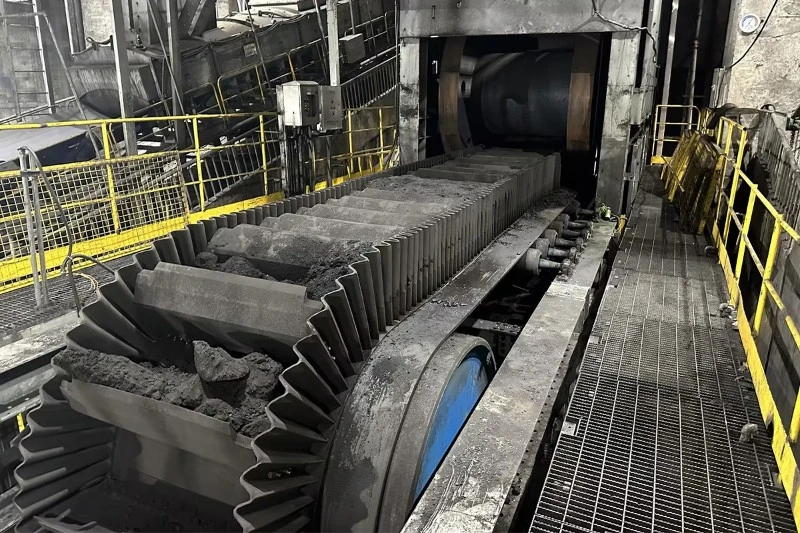
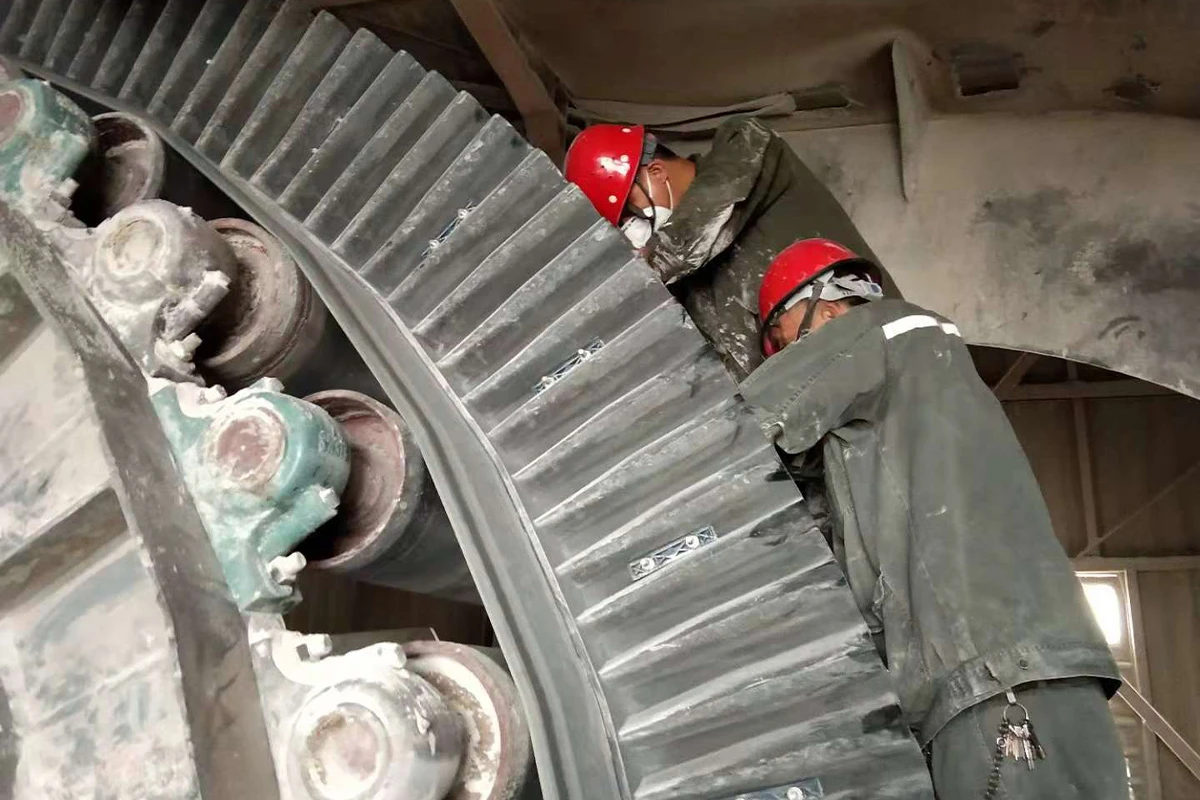
Start With the Rock, Not the Belt Specification
The most frequent mistake we see from buyers and distributors is opening an inquiry with dimensions first: "I need a 1000 mm wide sidewall belt with 250 mm corrugated sidewalls", while treating the material characteristics as an afterthought. For sharp abrasive rock applications, you must reverse this workflow. Six rock and operating properties dominate every subsequent specification decision:
• Maximum lump size: this sets minimum cleat height, pocket geometry and the risk of wedging between cleat and sidewall
• Particle angularity: rounded gravel behaves very differently from sharp, fractured blasted rock with knife-edge fragments
• Bulk density: together with hourly throughput, it defines belt loading, impact force and pocket overload risk
• Abrasiveness: determines the baseline rubber cover grade and the minimum cover thickness
• Drop height at loading point: the single biggest driver of impact cutting damage
• Operating incline: steeper angles mean rock settles firmly into pockets and rubs continuously against cover rubber during transit
One non-negotiable rule for sharp rock: cleat height must be at least 2.2 times the maximum lump dimension. If the lumps are dense and the conveyor angle exceeds 40°, raise the ratio to 2.5 times. Undersized cleats are not only a source of rollback and spillage - they also let oversized sharp lumps jam between the cleats and the corrugated sidewalls, peeling the sidewall-to-base bond and tearing the rubber at the cleat root. The belt may run clean at commissioning, but progressive tearing and spillage will appear within months.
A second critical distinction every distributor must understand: abrasion resistance and cut/gouge resistance are separate rubber performance metrics. A compound with very low abrasion loss against fine sand may still be brittle and split instantly under point impact from a sharp rock corner. This mismatch is the most common hidden trap when selecting sidewall belts for quarries.
|
DIN Cover Grade |
Minimum Tensile Strength (MPa) |
Minimum Elongation at Break (%) |
Max Abrasion Volume Loss (mm³) |
Cover Rubber Property Profile |
Suitability for Sharp Abrasive Rock |
|
X |
≥25 MPa |
≥450 % |
≤120 mm³ |
Premium heavy-duty; outstanding cut, tear and gouge resistance, balanced wear performance |
Preferred for large, sharp, high-impact hard rock: granite, basalt, blasted iron ore, quartz |
|
W |
≥18 MPa |
≥400 % |
≤90 mm³ |
Superior continuous abrasion resistance, good cut resistance, cost-effective heavy-duty option |
Recommended for medium sharp rock, crushed aggregate, high-volume abrasive fines mixed with small lumps |
|
Y |
≥20 MPa |
≥400 % |
≤150 mm³ |
General-purpose wear compound, moderate cut resistance |
Only acceptable for rounded gravel, fine crushed rock with no sharp angular fragments; NOT suitable for blasted hard rock |
|
Z |
≥15 MPa |
≥350 % |
≤200 mm³ |
Economy light-duty compound, low tear strength |
Unsuitable for any sharp or heavily abrasive rock application |
Note: a lower abrasion loss value means slower material removal under continuous sliding wear. DIN X trades a small amount of pure abrasion performance for much better impact and gouge resistance, which is why it is the first choice for high-lump-impact quarry circuits. ISO 10247 classifies this cut-and-gouge duty level as ISO category H - the same level the table above lists as "Severe Cut & Gouge Service". In other words, a DIN X cover is commonly supplied to meet the ISO H requirement, but the two systems are graded and tested separately and should be quoted by their own designation.
Cleat Profile, Bonding Quality and Loading Impact Control
Corrugated sidewall belts can operate from low horizontal angles all the way to vertical lifting, but no single cleat design handles sharp rock equally well. Standard T and C profile cleats work fine for light, low-impact bulk materials, but sharp rock demands reinforced, hot-vulcanized cleats. Cold-bonded cleat assemblies fail quickly under repeated rock impact, because impact shock breaks the adhesive bond line between cleat and base belt.
For sharp rock conveying, the heavy-duty choice is a TC-profile cleat with a reinforced root (TC-X grade). The extra fabric at the root protects the highest-stress point, where impact tears usually start. Note that TC-XS is a different build: it adds a flexible cushioning layer and is intended for fragile products such as coke, sinter and glass cullet, not for angular hard rock. All cleats and corrugated sidewalls must be hot-vulcanized integrally to the base belt, with a minimum peel adhesion of 17 N/mm measured on a 25 mm wide specimen before aging. That factory control value is deliberately held well above the 10 kN/m (equivalent to 10 N/mm on a 25 mm specimen) that MT/T 668-2019 requires for cover-to-core adhesion. MT/T 668-2019 is the Chinese coal-industry standard for steel-cord fire-resistant belting, so the comparison is only indicative for a textile EP sidewall belt - make sure any tender reference cites the standard that actually governs the belt and market in question. Any sidewall belt built for quarry rock duty that relies on cold glue bonding carries a very high risk of premature cleat or sidewall separation.
Loading zone design often matters more than cover grade selection. Even a premium DIN X sidewall belt with a 6 mm top cover will suffer severe cutting if sharp rock free-falls more than 500 mm directly onto the belt pocket. For sharp rock, feed should land on a horizontal lead-in section before the incline begins, fitted with impact beds and lined transfer chutes to dissipate the drop energy. Without impact control you will see random deep puncture cuts that no rubber compound can fully prevent.
|
DIN Cover Grade |
Top Cover Thickness |
Average Observed Service Life |
Dominant Failure Mode Seen In Field |
|
DIN Z |
3 mm |
2–3 months |
Deep penetrating cuts, rubber chipping, rapid carcass exposure |
|
DIN Y |
4 mm |
4–6 months |
Progressive gouging, cleat root abrasion, occasional lump punctures |
|
DIN W |
6 mm |
16–20 months |
Slow, uniform surface abrasion; rare isolated gouges |
|
DIN X |
6 mm |
20–24 months |
Minor surface scuffing; failures limited to extreme unplanned impact events |
The dataset is drawn from 37 quarry sidewall installations tracked between 2023 and 2025 - DIN Z 4, DIN Y 9, DIN W 14 and DIN X 10 (see Table 2). Grade and cover thickness vary together in this sample, so only the W-versus-X pair (both 6 mm) is a like-for-like comparison: W gave 16–20 months of service and X 20–24 months, a 25–30% gain for one grade step. Across the whole group, service life falls by more than 60% where the drop height exceeds 800 mm and no impact protection is fitted.
Belt Geometry, Freeboard and Pulley Sizing Rules
Once cover grade and cleat profile are locked in, the physical geometry of the belt system still creates hidden failure points that distributors frequently overlook. Sharp rock sidewall belts require extra attention to freeboard, cleat spacing and pulley sizing.
Leave 25–50 mm of freeboard between the loaded material line and the top edge of the corrugated sidewall. Less freeboard leads to rock being trapped between the sidewall and chute liners, which abrades and slices the sidewall rubber as the belt moves. More freeboard simply adds unnecessary rubber cost.
Cleat pitch, the center-to-center distance between adjacent cleats, should fall between 2 and 3 times the cleat height for sharp rock duty. Too close, and rock cannot settle properly into the pocket during loading; too wide, and pockets overload at steep angles, letting sharp lumps shift and gouge the cover during lifting.
The base belt carcass needs transverse rigidity, usually added with a breaker fabric layer, to resist cupping and flex cracking under heavy rock loads. Cleat roots are permanent stress concentration points; the embedded reinforcement layer here directly reduces tear propagation risk.
Pulley diameter rules are different for sidewall belts compared to flat conveyor belts. The corrugated sidewall compresses and stretches every time it wraps around the head and tail pulley. If the pulley diameter is too small relative to sidewall height, the corrugated rubber fatigues and cracks long before the top cover wears out. Table 4 at the end of this section summarises the working rules for sharp rock duty.
|
ISO Service Category |
Duty Description |
Typical Material Stream |
Recommended DIN Cover Grade |
|
H - Severe Cut & Gouge Service |
Large sharp lumps, high point impact, abrasive rock |
Blasted granite, hard iron ore, basalt, quartzite |
DIN X |
|
D - Severe Abrasion Service |
High volume abrasive fines mixed with small sharp chips |
Crusher fines, sharp aggregate chips, sinter |
DIN W |
|
L - Moderate Duty Service |
Low-abrasion, rounded bulk materials |
Rounded river gravel, coal, clay, grain |
DIN Y / DIN Z |
Rubber Compound Matching and Document Verification
One of the most common cost-cutting tricks from low-tier manufacturers is supplying a base belt with DIN W or DIN X cover rubber while molding the corrugated sidewalls and cleats from cheaper DIN Y grade rubber. The base belt may hold up well, but the sidewalls and cleats wear, crack and delaminate first, creating an early failure point even though the main belt carcass remains intact.
When you request data sheets and test certificates, always verify that the rubber compound specification applies to the base belt cover, the corrugated sidewall and the cleats as one assembly. The peel strength test report between sidewall and base belt is just as important as the abrasion certificate for the cover rubber. For mining and quarry tenders, ask for the full documentation: ISO 4649 abrasion results with the test load stated (10 N or 5 N), tensile and elongation certificates, vulcanization peel strength records, and formal grade declarations. Avoid suppliers that use only vague marketing wording such as "heavy wear resistant" without published laboratory figures.
For underground hard-rock tunneling or mining applications, add flame-retardant and anti-static requirements to the specification wherever site rules demand FRAS performance; the same applies to MSHA acceptance in US underground coal service. Do not assume these properties are included - confirm which test requirements apply (EN 12882, AS 4606 or MT/T 668) and who holds the certificate at the inquiry stage.
|
Parameter |
Required Specification Rule for Sharp Abrasive Rock |
Consequence If This Item Is Ignored |
|
Maximum lump size limit |
Lump size ≤ 45% of cleat height, i.e. cleat height ≥ 2.2 × maximum lump |
Lump wedges between cleat and sidewall, tears sidewall bond |
|
Cleat construction |
TC cleat with reinforced root (TC-X), hot-vulcanized integral build |
Cold bonded cleats peel off rapidly under cyclic rock impact |
|
Minimum top cover thickness |
5–6 mm for DIN W / DIN X; bottom cover 2–3 mm |
Thin top cover is punctured and cut through quickly |
|
Minimum pulley diameter |
≥ 3.5 × sidewall height and never below 400 mm - e.g. 120 / 160 / 200 mm sidewall → 500 / 630 / 800 mm pulley |
Small pulleys create sidewall fatigue cracking |
|
Loading configuration |
Horizontal feed zone before incline, impact bed fitted |
Vertical drop impact creates unavoidable deep cuts |
Note: values are working rules for preliminary selection. Final cleat height, pitch and pulley diameter should be confirmed against the manufacturer's drawing, the claimed throughput and the governing standard for the destination market.
Information to Send with Your Inquiry
The fastest route to an accurate, durable belt specification is a structured inquiry pack. The slowest is asking for "the same sidewall belt as last time" - especially when the rock source, crusher settings or throughput rate have changed. Include these details:
• Rock type, bulk density, particle angularity
• Maximum lump size and full particle size distribution
• Hourly throughput and belt operating speed
• Lift height, horizontal run length and conveyor incline angle
• Material drop height at loading chute
• Material temperature and ambient operating conditions
• Photos and failure history of any previously failed belt
• Mandatory standards, certification and test report requirements
Two commercial details belong in the same pack, because they decide the quotation as much as the specification does:
• Required delivery date, destination port and packing requirements - these decide the production slot and the container plan.
• Preferred splice method and whether site splicing support is needed - this determines whether splice rubber, cover strips and supervision must travel with the belt.
With this information, the engineering team can return a complete specification - sidewall height, reinforced cleat profile, cleat pitch, matched cover grade, cover thickness and pulley guidance - usually within one working day, before commercial pricing is discussed.
Four Costly Mistakes Distributors Should Avoid
• Selecting cleat height purely from capacity tables. Lump size sets the minimum cleat dimension. A belt rated for 500 t/h of fine dust cannot safely contain 150 mm sharp rock lumps.
• Specifying cold-bonded cleats for steep, high-tonnage rock circuits. Cold bonding works acceptably for light-duty, low-impact materials; it becomes a constant maintenance burden with sharp rock impact.
• Calculating pulley sizes using flat belt rules. The corrugated sidewall undergoes repeated flexing over pulleys, so sidewall height must be factored into pulley diameter selection.
• Reusing an old belt specification when site conditions change. If the quarry moves to a harder rock seam, crusher output produces larger lumps, or throughput increases, the old spec is no longer valid.
Commercial Terms to Settle Before You Quote Your Customer
Most first-round distributor questions are commercial, not technical. Six items are worth settling at the inquiry stage, so that the quotation you pass on to your customer is one you can actually hold:
• MOQ and container loading - one belt is enough to start, and mixed specifications can share a container. Ask for the loading plan with the quote: belt weight per roll, roll diameter and core size decide how many meters fit in a 20 ft or 40 ft container.
• Lead time and mold status - standard cleat and sidewall molds are held in-house; a new cleat height or pitch adds tooling time. Ask which of your sizes are standard builds and which need a new mold.
• Price ladder across grades - expect roughly an 8–12% step from DIN W to DIN X on the same build, against the 25–30% longer service life shown in Table 2 and the 30–70% longer life shown in Table 1. Ask for the quotation broken down by grade, so you can show the end user the trade-off instead of defending a higher unit price.
• Splice support - confirm that splice rubber, cover strips and a written vulcanizing procedure are supplied with the belt, and whether on-site supervision is available for the first splice. This is the most common after-sales dispute with sidewall belts.
• Warranty position - get the warranty in writing, with the adhesion limits and cover thickness tolerance stated, and a named claim procedure. Cold-bonded cleats fitted outside the factory, undersized pulleys and unprotected high drops are the three exclusions behind almost every real claim.
• Certification and documentation - ISO 4649 abrasion, tensile and peel reports, a formal grade declaration, plus FRAS, MSHA or other certificates where the destination market requires them.
This is also how we quote: grade and thickness stated on the drawing, laboratory data attached to the offer, and a loading plan included with the price. If any of the six items above is missing from a supplier's first reply, the specification is not yet firm enough to price.
If you need high-quality corrugated sidewall belts, please contact us. We can provide professional technical support, complete product specifications, relevant test certificates and customized solutions to meet your actual on-site operating requirements.
Email: sunny@bestfriendrubber.com
WhatsApp / Tel: +86 139 6972 9233
Inquiry form: https://www.qbfrubber.com/inquiry
Product page: Corrugated Sidewall Conveyor Belt - https://www.qbfrubber.com/sidewall-conveyor-belt/corrugated-sidewall-conveyor-belt.html
FAQ
Q: Can I specify DIN Y grade to cut project cost when the sharp rock is only 20–40 mm?
A: We advise against it. DIN Y rubber is engineered for moderate sliding abrasion, not point-impact cutting from angular rock edges. The belt may look satisfactory at commissioning, but field data shows gouging and cover rupture typically develop within 4–6 months, and that leads to end-user complaints and warranty claims. If budget control is the priority, the better-balanced option is DIN W compound with a 5 mm top cover, rather than downgrading the rubber grade.
Q: What is the practical difference between abrasion resistance and cut/gouge resistance?
A: Abrasion resistance quantifies rubber loss from continuous sliding friction against abrasive grains, measured by the ISO 4649 rotating-drum abrasion test. Cut and gouge resistance describes the rubber's ability to resist penetration, tearing and crack propagation when a sharp rock edge strikes with impact force. Some high-abrasion blends are relatively rigid and brittle: they wear slowly under fine sand but split open immediately when struck by sharp rock. Quarries processing blasted hard rock need both properties balanced correctly.
Q: Will a higher-tensile EP carcass compensate for a lower-grade cover rubber?
A: No. The fabric carcass provides tensile strength to carry the conveyor tension load; it offers zero protection against impact cuts and gouging damage to the cover rubber. A heavy-duty EP500 carcass fitted with a DIN Z economy cover will still be sliced through quickly by sharp rock. Carcass rating and cover rubber grade are two independent selection parameters, and neither can substitute for the other.
Q: Can corrugated sidewall belts lift sharp rock vertically, i.e. at a 90° incline?
A: Mechanically the belt design supports steep-angle and vertical lifting, but the loading design becomes extremely critical. Sharp rock must be fed gently into the belt pocket on the horizontal lead-in section before the vertical rise starts. Dropping sharp rock straight down onto the vertical belt pocket creates concentrated point impact, which punches holes in the cover regardless of whether you select DIN W or DIN X grade. Impact beds and lined, curved feed chutes are mandatory accessories for vertical rock lifting.
Q: Which inspection documents should I collect from the factory before reselling these belts?
A: Request the ISO 4649 abrasion report with the test load stated, the tensile and elongation certificate, the sidewall-to-base vulcanization peel strength record, and a formal grade declaration covering cover, sidewall and cleat rubber. Avoid suppliers that offer only generic product descriptions without verifiable laboratory data. For mining and tender projects, confirm third-party certification before confirming the order.


