


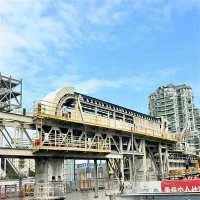


Vertical Sidewall Conveyor Belt For 90° Lift
Qingdao Best Friend Rubber & Plastic Co., Ltd. is one of the most reliable manufacturers and suppliers of vertical sidewall conveyor belt for 90° lift in China, also supports customized service. If you're going to buy high quality vertical sidewall conveyor belt for 90° lift made in China, welcome to get more information from our factory.
A vertical sidewall conveyor belt lifts bulk material straight up - 90° from horizontal - in one continuous flight: no transfer tower, no bucket elevator, no intermediate conveyor. It can because the load rides in closed pockets formed by corrugated sidewalls and transverse cleats, not on friction between material and belt surface, which is what limits a smooth belt to roughly 18°.
Two things decide whether a 90° lift works, and neither is belt width: pocket geometry, and the two bends where the belt leaves and re-enters the horizontal. QBF builds these belts 300–2400 mm wide with sidewalls 40–630 mm high and cleats in C, T, TC and TC-XS profiles, hot-vulcanised in one cycle.
Technical Specifications
Vertical Lift Selection Matrix - how the geometry is set
|
Sidewall height |
Cleat profile at 90° |
Max. lump size |
Min. pulley dia. (reference) |
|
60 – 120 mm |
T / C |
≤ 60 mm |
≥ 315 mm |
|
120 – 200 mm |
C / TC |
≤ 100 mm |
≥ 500 mm |
|
200 – 320 mm |
TC / TC-XS |
≤ 160 mm |
≥ 800 mm |
|
320 – 630 mm |
TC-XS |
≤ 300 mm |
≥ 1000 mm |
|
Parameter |
Value |
|
Conveying angle |
0° – 90° |
|
Belt width |
300 – 2400 mm |
|
Sidewall height |
40 – 630 mm |
|
Cleat height / profile |
55 – 600 mm;C / T / TC / TC-XS |
|
Base belt carcass |
织物 EP / NN 或钢丝绳芯,250 – 10000 N/mm |
|
Bond strength |
> 17 N/mm |
|
Cover compound |
NR / SBR / CR / EPDM;磨耗 ≤ 120 mm³ |
|
Certification |
ISO 9001 |
Why It Holds Up
Capacity comes from pocket geometry, not belt width. Throughput is Q = 3600 × pocket area × speed × bulk density × fill factor. Two belts of the same width can differ by 30% purely on cleat pitch and pocket depth, so ask for capacity in pocket volume, not in millimetres of belt.
The two bends are where 90° belts fail. Going into and out of the vertical leg, the sidewall is compressed on the inside of the curve. Too small a pulley and the corrugation buckles, then cracks at the base of the folds - the most common warranty claim on steep-angle belts. Minimum pulley diameter rises with sidewall height; see the matrix above.
Above roughly 30 m of lift, the carcass decision changes. Fabric EP carcasses elongate around 1.5–2.5%, steel cord under 0.2%. Stretch lengthens the cleat pitch, pockets lose volume, and the belt tracks badly on the pulleys.
Sticky material is the one condition a vertical belt does not solve. Wet clay, laterite and green sand do not fall out of the pockets at discharge. It is handled - C or TC profiles, scrapers, lower speed - but it must be declared at enquiry, because a pocket that does not empty carries the load back down.
Applications
Mining - pit-to-surface and underground-to-silo lifts
Vertical lifts beyond about 30 m put the base belt into steel cord territory. The alternative is usually a bucket elevator, which means more wearing parts and degradation at the boot.
Cement and lime plants - silo feed inside a fixed footprint
Retrofits are decided by what fits. Feeding a 40 m silo at 30° needs roughly 70 m of run; a vertical leg needs only the tower footprint. This is the most common reason the belt gets specified at all.
Tunnel boring and shaft mucking
Behind a TBM there is no room for an incline, and the belt must advance with the machine. A vertical leg takes muck from the screw conveyor to the muck cars.
Grain, biomass and wood products
Bucket elevators crack grain and generate dust at the boot. Pockets load without digging and carry it up intact, which is why food-grade covers are usually specified here.
FAQ
Q: Can a sidewall belt really run at a true 90°?
Yes, but only the middle of the run is vertical. The belt loads horizontally, turns through a bend into the vertical leg, then turns back. Those bends need correctly sized pulleys or deflection wheels; if the radius is too small, the sidewall buckles and cracks at the folds.
Q: How much capacity do I lose going from 30° to 90°?
Capacity is Q = 3600 × pocket area × speed × bulk density × fill factor, and the fill factor is what drops. A horizontal belt carries across nearly full width; at 90° the pockets fill to roughly 0.6–0.75 of their volume.
Q: How does a vertical screw conveyor belt work?
A: The material rotates with the screw at high speed, and the material to be conveyed is added from the feed port of the horizontal part, and is sent to the conveyor and the vertical part through the rotating horizontal feed screw, and then the material is pushed up to the discharge port.
Q: What are the safety requirements for vertical screw conveyor belts?
A: Exercise caution around all conveyed material. Prohibit loose hair, clothing, and jewellery. Never stand, sit, work, or ride on conveyor belts or roller tracks. Watch for the conveyor operating incorrectly or missing guards.
Hot Tags: vertical sidewall conveyor belt for 90° lift, China vertical sidewall conveyor belt for 90° lift manufacturers, suppliers, factory, Anti stick Sidewall Conveyor Belt, clearance of sidewall conveyor belts, durable sidewall conveyor belt, packaging of sidewall conveyor belts, rubber sidewall conveyor belt, uv resistant sidewall conveyor belt
Previous
No InformationNext
No InformationYou Might Also Like




Send Inquiry