


In mining, quarrying, cement production, and other heavy-duty bulk material handling operations, conveyor belt damage often begins at the loading point. Large rocks, ore lumps, and sharp-edged materials can strike the belt with considerable energy, causing cover cuts, carcass punctures, and even longitudinal tearing.
For plant operators, these failures mean more than replacing a damaged belt. An unexpected shutdown may interrupt the entire material handling process, increase maintenance costs, and delay production schedules.
However, installing a thicker conveyor belt is not always the solution. Effective impact protection depends on several factors, including material drop height, lump size, belt construction, chute design, and the support system beneath the loading area.
This article explains how to evaluate impact risks, improve loading point protection, and select appropriate conveyor belts for demanding industrial applications.
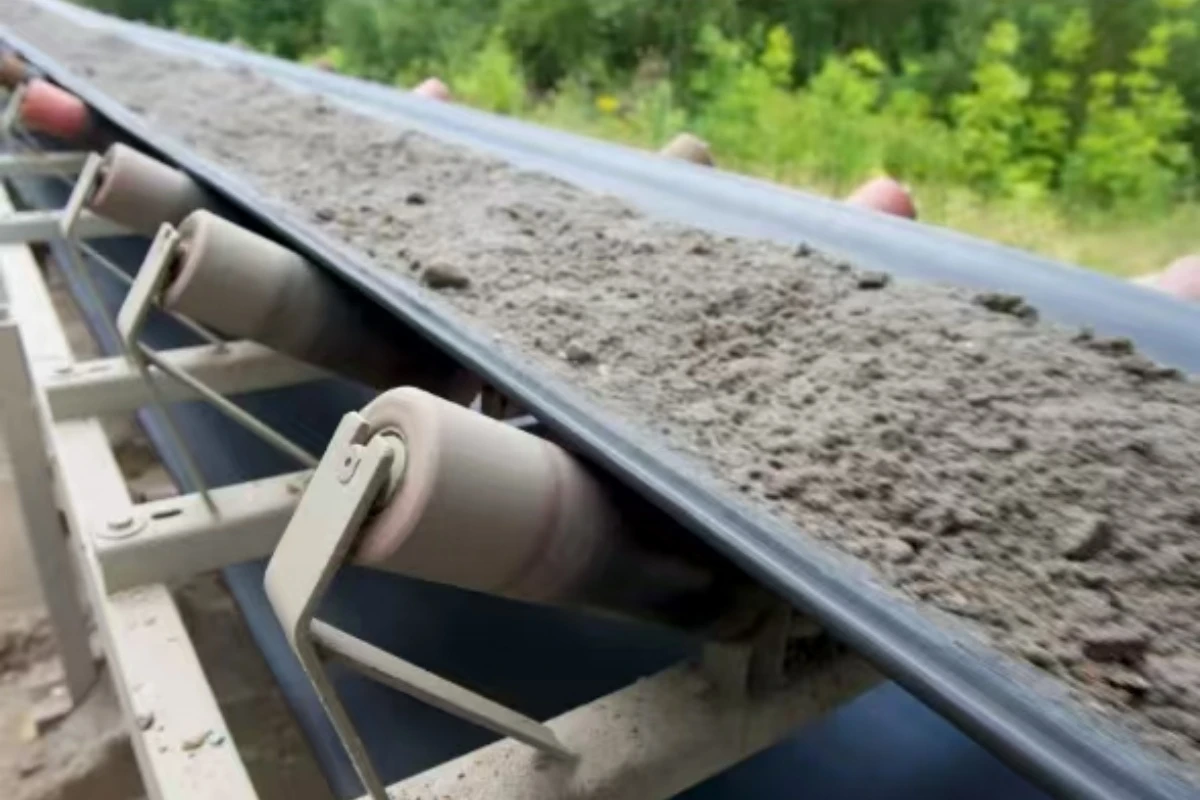
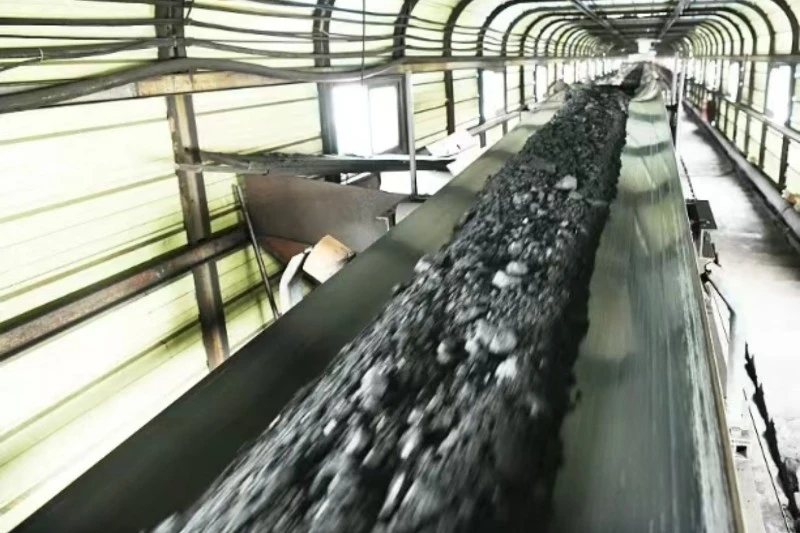
Why Do Conveyor Belts Suffer Impact Damage at Loading Points?
A conveyor loading point is where material transfers from a hopper, crusher, or another conveyor onto the receiving belt.
During this transfer, the material may fall vertically, strike the belt at an angle, or land unevenly across its width. When the impact exceeds what the belt and its supporting structure can accommodate, damage may occur.
The most common causes include:
Excessive Material Drop Height
The greater the vertical distance a material falls, the more gravitational potential energy it can convert into kinetic energy before reaching the belt.
For example, large ore lumps falling directly from a crusher discharge can cause concentrated impact loads, particularly if the receiving belt is insufficiently supported.
Sharp and Irregular Material Shapes
Angular rocks, metal scrap, and crushed minerals can create high local contact stresses. Sharp edges may penetrate or cut the rubber cover, damaging the carcass underneath.
A belt may have sufficient tensile strength for normal operation but still be vulnerable to localized punctures.
Inadequate Loading Point Support
Without suitable impact idlers or impact beds, the belt can deflect excessively when heavy material lands on it.
This movement increases the risk of damage around the supporting rollers and can contribute to material spillage and poor sealing.
Improper Material Loading Direction
When material enters the receiving belt at an unsuitable angle or lands away from its center, it can cause uneven loading, excessive wear, and belt mistracking.
These problems are particularly important in high-capacity mining conveyors, where repeated impact and uneven loading can accelerate equipment deterioration.
How Much Impact Energy Can Falling Material Generate?
Material impact energy is an important starting point for evaluating loading point protection.
For an object falling vertically from rest, neglecting air resistance, its gravitational potential energy can be estimated using:
E = m × g × h
Where:
· E: Impact energy in joules (J)
· m: Mass of the falling material in kilograms (kg)
· g: Gravitational acceleration, approximately 9.81 m/s²
· h: Vertical drop height in meters (m)
Table 1. Calculated Impact Energy at Different Drop Heights
The following example assumes a single 30 kg rock falling vertically from rest without intermediate contact.
|
Drop Height |
Rock Mass |
Calculated Impact Energy |
|
0.5 m |
30 kg |
147 J |
|
1.0 m |
30 kg |
294 J |
|
1.5 m |
30 kg |
441 J |
|
2.0 m |
30 kg |
589 J |
Note: Values are rounded theoretical calculations, not conveyor belt impact ratings or actual field measurements.
At the same material mass, increasing the drop height from 0.5 m to 2.0 m increases the calculated impact energy by a factor of four.
This demonstrates why reducing unnecessary drop height can be an effective way to limit loading point damage.
However, impact energy should not be confused with impact force. Actual peak force also depends on the contact area, stopping distance, belt deformation, support stiffness, and incoming material velocity.
For continuous material flow, individual lump energy alone is insufficient to determine impact bed capacity. The conveyor's flow rate and support-system characteristics must also be considered.
Procurement consideration: Before selecting a heavy-duty belt or impact bed, buyers should provide the maximum lump size, estimated lump mass, drop height, and conveying capacity.
What Types of Damage Should Operators Look For?
Different damage patterns may indicate different loading point problems.Identifying the failure mechanism helps operators avoid replacing the belt without correcting the underlying cause.
Table 2. Common Loading Point Damage and Corrective Measures
|
Damage Type |
Possible Cause |
Recommended Action |
|
Surface cuts and gouges |
Sharp-edged rocks striking or sliding across the cover |
Review cover compound, drop trajectory, and chute design |
|
Belt punctures |
Concentrated impact from heavy or angular material |
Evaluate reinforced belt construction and impact support |
|
Longitudinal tearing |
Trapped sharp objects or material penetrating and catching in the belt |
Consider breaker reinforcement, tramp-metal removal, and rip detection |
|
Cover separation |
Repeated loading stress, poor adhesion, or other operating factors |
Check cover-to-carcass adhesion and loading conditions |
|
Belt sag and spillage |
Insufficient support or excessive spacing between idlers |
Improve support with properly selected impact beds or idlers |
|
Edge damage and mistracking |
Off-center loading or contact with conveyor structure |
Correct material trajectory and inspect belt alignment |
One important distinction is that impact resistance and tear resistance are not identical.Impact resistance relates to how the belt responds to concentrated loading or shock. Tear resistance, particularly longitudinal tear propagation resistance, relates to the belt's ability to resist further tearing after damage has started.Consequently, buyers should evaluate both properties when handling sharp and heavy materials.
Five Practical Ways to Protect Conveyor Belts from Heavy Impact
Reduce Material Drop Height and Improve Chute Design
The most direct way to reduce impact exposure is often to improve how material reaches the receiving belt.For example, a properly designed transfer chute or rock box can redirect the material stream and reduce the effective free-fall distance.Rock boxes allow material to accumulate and form a protective layer so incoming rocks strike other material rather than falling directly onto the receiving belt.Where appropriate, the chute should also guide material toward the center of the belt and align its horizontal velocity with the belt's direction of travel.This helps reduce direct impact, uncontrolled sliding, and off-center loading.A chute modification must still be evaluated for flow restrictions, buildup, liner wear, and maintenance accessibility.
Install Suitable Impact Beds or Impact Idlers
Impact beds and impact idlers support the belt beneath the loading zone and help manage the energy of falling materials.
Impact idlers may be suitable for certain loading conditions. In more demanding applications, properly designed impact beds can provide additional continuous support and help maintain a stable belt line.An impact bed commonly combines a low-friction sliding surface with an energy-absorbing layer.
For example, QBF Rubber's impact bar design uses an UHMWPE upper surface and an elastic rubber base to provide sliding support and impact cushioning.
Select a Conveyor Belt with Suitable Reinforcement
A reinforced belt can provide additional protection when sharp or heavy materials create a risk of puncture and tearing.
RipStop/Breaker conveyor belts incorporate a reinforcement layer designed to help resist cutting and the propagation of damage.
Depending on the belt design, transverse steel reinforcement may be positioned above the textile carcass to provide additional protection against sharp-edged materials.These constructions can be particularly useful in stone quarries, cement plants, foundries, and scrap-handling applications.
However, breaker reinforcement does not make a belt impossible to puncture or tear. Protection must be matched to the application and supported by appropriate test data.
Choose the Right Rubber Cover Properties
The top cover protects the load-bearing carcass from direct contact with conveyed material.
For abrasive bulk materials, buyers should consider cover abrasion resistance, thickness, and mechanical properties. When cutting and gouging are the main concerns, rubber tear strength and the suitability of the overall belt construction also matter.A thicker cover may provide additional sacrificial material before the carcass becomes exposed. However, it cannot compensate for poor loading point support or unsuitable chute geometry.Excessive cover thickness also adds belt weight and may affect flexibility and pulley requirements.Therefore, cover thickness and compound selection should be evaluated together rather than independently.
Control Material Size and Remove Dangerous Objects
Large, irregular lumps and foreign objects can create additional impact and puncture risks.
Where suitable for the process, plants can use screening, controlled feeding, grizzlies, and tramp-metal removal equipment to reduce these hazards before material reaches the conveyor.
Regular inspection of chute liners and loading point components is also essential. A damaged liner or loose metal part can become a serious source of belt tearing.For high-consequence installations, belt rip-detection systems may also help limit the length of damage by initiating a shutdown after a tear is detected.
Which Conveyor Belt Is Suitable for Heavy-Impact Applications?
The best belt depends on the combination of impact exposure, required tensile strength, conveyed material, and conveyor geometry.
Table 3. Conveyor Belt Options for Different Loading Conditions
|
Conveyor Belt Type |
Main Characteristics |
Suitable Applications |
|
RipStop/Breaker Conveyor Belt |
Additional reinforcement to improve protection against cutting and tearing |
Quarries, cement plants, foundries, sharp aggregate handling |
|
Steel Cord Conveyor Belt |
High longitudinal tensile strength and low elongation; optional protective reinforcement depending on design |
Long-distance, high-tension mining and heavy-duty conveying |
|
EP Fabric Conveyor Belt |
Multi-ply textile construction with flexible troughing characteristics |
General bulk handling and selected impact-loading conditions |
|
Abrasion-Resistant Conveyor Belt |
Rubber cover selected for wear resistance |
Limestone, crushed stone, ore, and other abrasive materials |
These categories are not mutually exclusive. For example, a steel cord or textile belt may also incorporate additional breaker reinforcement and a suitable abrasion-resistant cover.
Buyers should not assume that a high-tensile-strength steel cord belt is automatically more puncture-resistant than every textile belt. Tensile capacity and localized impact resistance are different design considerations.
For high-impact applications, belt construction should be selected only after evaluating the loading conditions and the complete conveyor system.
What Technical Data Should Buyers Check Before Ordering?
When purchasing a replacement conveyor belt, it is tempting to order the same width and tensile rating as the existing belt.
However, if the original belt failed because of repeated impact or puncture, matching the previous specification may reproduce the same problem.
A more effective procurement process starts with reviewing the belt construction, operating conditions, and failure history.
Table 4. Technical Information for Heavy-Impact Conveyor Belt Procurement
|
Parameter |
Information to Confirm |
Why It Matters |
|
Belt width |
Required width in mm |
Determines compatibility with the conveyor structure |
|
Belt tensile rating |
EP/NN rating or ST rating in N/mm |
Ensures appropriate longitudinal strength |
|
Cover thickness |
Top and bottom cover thickness in mm |
Helps determine available cover protection and belt construction |
|
Carcass structure |
Textile plies, steel cords, and optional breaker layers |
Influences tensile performance and damage resistance |
|
Maximum lump size |
Largest expected particle dimensions in mm |
Helps evaluate impact concentration and loading risks |
|
Maximum lump mass |
Estimated weight of the largest individual lump |
Supports preliminary impact analysis |
|
Drop height |
Effective vertical drop distance in m |
Influences calculated impact energy |
|
Conveyor capacity |
Operating and peak throughput in t/h |
Determines continuous loading requirements |
|
Conveyor speed |
Operating speed in m/s |
Affects material transfer and loading dynamics |
|
Support arrangement |
Impact idlers, impact beds, and support spacing |
Determines how loads are supported beneath the belt |
For projects where longitudinal tearing is a major concern, ISO 505:2025 provides a standardized method for evaluating tear propagation resistance in textile conveyor belts.
ISO 252:2023 specifies methods for testing adhesion between conveyor belt components, including the covers and carcass.
Neither test alone proves that a belt can withstand a specified falling-rock impact. For critical applications, buyers should ask for relevant impact, puncture, or full-belt test data where available, including the test configuration and acceptance criteria.
How to Evaluate the Cost of Impact Protection
Replacing a damaged belt involves more than the price of the new belt.Plant operators may also incur costs from lost production, installation labor, splicing, cleaning, and damaged conveyor components.
A useful comparison is to evaluate:
Total Operating Cost = Belt Purchase Cost + Installation and Maintenance Costs + Downtime Losses
For example, a reinforced conveyor belt may cost more initially than a standard belt. However, if it reduces unplanned replacement frequency under verified operating conditions, it may provide a lower total cost over the project period.
The same principle applies to impact beds and chute modifications.Rather than purchasing an upgraded belt alone, buyers should compare the cost of the complete protective solution against the risk and expense of continued failures.Any predicted service-life improvement should be based on actual application data, documented testing, or comparable operating records-not an assumed percentage.
Our Project Support
Qingdao Best Friend Rubber & Plastic Co., Ltd. provides conveyor belt solutions for heavy-duty bulk material handling, including RipStop/Breaker conveyor belts, steel cord conveyor belts, and impact bar/bed products. In mining, quarrying, and cement operations, effective belt protection depends not only on rubber cover quality or reinforcement, but also on the interaction between material impact, belt construction, loading chute geometry, and support arrangements. Our team helps buyers evaluate these factors to identify suitable belt specifications and protective solutions.
If your conveyor system experiences repeated punctures, cover damage, or longitudinal tearing at loading points, send us your conveyed material, maximum lump size, drop height, belt dimensions, conveying capacity, and operating conditions. We can review your requirements, recommend suitable conveyor belt options, and prepare a quotation based on your project needs.
Email: sunny@bestfriendrubber.com
WhatsApp / Tel: +86 139 6972 9233
Inquiry form: https://www.qbfrubber.com/inquiry
FAQ
Q: Does a thicker conveyor belt provide better impact resistance?
A: Not necessarily. A thicker rubber cover can offer additional protection against wear and localized damage, but impact resistance also depends on the rubber compound, carcass construction, reinforcement, and loading support. A thicker cover alone may not prevent punctures from sharp rocks.
Q: What is the difference between an impact-resistant and a tear-resistant conveyor belt?
A: Impact-resistant designs are intended to withstand shock loading, while tear-resistant designs focus on limiting cutting or tear propagation. Some reinforced constructions are designed to address both risks, but the relevant performance should be verified separately.
Q: Are impact beds necessary for every heavy-duty conveyor?
A: No. Impact idlers may provide adequate support in some applications. For severe loading, heavy lumps, or applications requiring continuous support beneath the loading zone, an engineered impact bed may be preferable.
The correct choice depends on the operating conditions and impact-support calculations.
Q: Can a damaged conveyor belt be repaired instead of replaced?
A: Minor localized cover damage may be repairable depending on the belt construction and damage severity. However, significant carcass damage, longitudinal tearing, or structural deterioration may require a more extensive repair or replacement.A qualified inspection should determine whether the belt can safely return to service.
Q: What information should I provide when requesting an impact-resistant conveyor belt quotation?
A: Provide the conveyed material, maximum lump size and mass, drop height, belt width, belt speed, operating capacity, tensile strength requirements, and existing belt construction.If possible, include photographs of the loading point and damaged belt so the manufacturer can better understand the failure conditions.


