


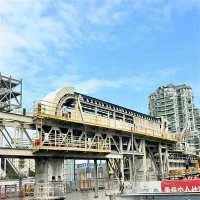


Heat Resistant Conveyor Belt
QBF provides belts for:
- Medium-temperature use (≤100°C surface temp)
- High-temperature use (≤200°C surface temp)
- Special applications
Qingdao Best Friend Rubber & Plastic Co., Ltd. is one of the most reliable manufacturers and suppliers of heat resistant conveyor belt in China, also supports customized service. If you're going to buy high quality heat resistant conveyor belt made in China, welcome to get more information from our factory.
Heat Resistant Conveyor Belt is an industrial conveyor belt specifically designed for transporting high-temperature materials. It ensures the continuous, efficient and stable operation of production lines in high-temperature environments and is widely used in industries such as steel, cement, metallurgy and mining.
Technical specifications
|
Cover characteristic |
Variation for belt class |
||||
|
T1 |
T2 |
T3 |
T4 |
||
|
Hardness (IRHD) |
- variation of initial value |
+20 |
+20 |
+20 |
+20 |
|
- maximum value |
85 |
||||
|
Tensile strength (N/mm2) |
- variation in percentage of initial value |
-25 |
-30 |
-40 |
-40 |
|
- minimum value |
12 |
10 |
5 |
5 |
|
|
Elongation at break (%) |
- variation in percentage of initial value |
-50 |
-50 |
-55 |
-55 |
|
- minimum value |
200 |
200 |
180 |
180 |
|
|
- Class T1: resistant to test temperatures of up to 100 °C. |
|||||
|
- Class T2: resistant to test temperatures of up to 125 °C. |
|||||
|
- Class T3: resistant to test temperatures of up to 150 °C. |
|||||
|
- Class T4: resistant to test temperatures of up to 175 °C. |
|||||
The main advantages of Heat Resistant Conveyor Belt

1. High temperature adaptability:
Suitable for areas with environmental temperatures above 70℃. The transported materials have a high temperature, and the surface temperature of the conveyor belt can reach 100℃ - 200℃ or even higher.
2. Excellent wear resistance:
Using high-quality rubber materials specially designed, it can withstand high temperatures and resist wear, which also helps to reduce maintenance costs and extend the service life of the conveyor belt.
3. Material adhesion:
Excellent material adhesion means that the fabric layer or steel wire layer can remain together even at extremely high temperatures, ensuring the durability of the conveyor belt.
4. Good conveying performance:
It can achieve smooth and efficient transportation of materials, increase production efficiency and reduce downtime, which is crucial for maintaining smooth and efficient operation.
Applications
|
Industry |
Material |
Belt surface temp |
What governs the specification |
|
Cement |
Clinker from rotary kiln |
100 - 110 °C |
T3 EPDM, 6 - 8 mm top cover, heat-treated fabric carcass |
|
Cement |
Raw meal, dried clay, cement powder |
80 - 120 °C |
T2, standard or heat-treated fabric |
|
Steel and sintering |
Sintered ore discharge |
130 - 150 °C |
T3 to T4, thick cover, impact idlers at the discharge |
|
Steel and sintering |
Return sinter fines |
150 - 190 °C |
T4, steel cord carcass if tension is high, accept shorter life |
|
Coking |
Coke |
50 - 60 °C |
Heat resistance is rarely the constraint; abrasion governs |
|
Foundry |
Moulding sand, hot castings |
80 - 130 °C |
T2 to T3, watch for oil contamination from release agents |
|
Metallurgy |
Metal powder, hot pellets |
120 - 130 °C |
T3, cover hardness control |
|
Power generation |
Hot ash, coal |
- |
T2 to T3, check flame retardant requirement if applicable |
|
Chemical and fertiliser |
Hot chemical ash, fertiliser |
- |
T2, confirm chemical compatibility of the compound |
Operating rules that decide belt life
On a hot line the specification sets the ceiling and the operation decides where you land under it. These are the eight measures that most often make the difference between a belt lasting a season and a belt lasting two years.
- Reduce carrying idler spacing in the hot zone by 10 to 15 % compared with ambient service. Hot rubber is softer, so the belt sags further between idlers and the carcass fatigues faster.
- Check the minimum pulley diameter to ISO 3684. Typical minimums are 125 times the total belt thickness for fabric carcasses and 150 times the cord diameter for steel cord. Undersized pulleys bend a hot, softened belt too sharply.
- Give the return run enough length to cool. The belt should be back at a workable temperature by the time it reaches the tail pulley. On short lines, this is often the real limit on how hot you can run.
- Control the loading point. Use impact idlers, keep the drop height down, and set the chute skirt clearance correctly. A softened cover cuts and gouges far more easily than a cold one.
- Watch the idlers. A seized idler carbonises the bottom cover in a surprisingly short time, and no compound grade will protect against it. This is one of the most common causes of premature failure on hot lines.
- Consider raising the belt speed. Contact time is heat transfer, so a faster belt runs cooler if the duty allows it.
- Use hot vulcanised splicing only in the hot zone. Cold-bonded cements have a much lower service temperature and will let go at the splice first.
- Match belt cleaners to the belt temperature. A cleaner rated for ambient duty can damage a hot cover.
Send us the belt surface temperature - continuous and peak - along with the material and the lump size. Our engineers will come back with a specific compound, class and cover thickness, and the reasons behind each.
FAQ
Q: What is a heat resistant conveyor belt?
A: A heat resistant conveyor belt is a belt built to keep its mechanical properties while carrying material hotter than ambient - in practice above about 70 °C at the belt surface. It differs from a standard belt in three ways: a heat-stable cover compound, an adhesion system that holds up under heat, and a carcass that does not shrink at the working temperature.
Q: What is the difference between T1, T2, T3 and T4?
A: The class letter is the maximum continuous belt surface temperature the compound is qualified for: T1 is 100 °C, T2 is 125 °C, T3 is 150 °C and T4 is 175 °C, per ISO 4195. Each class also carries a short-term peak allowance above its continuous rating. The classes come from ageing tests, so they describe the belt after heat exposure, not on the day it ships.
Q: Is the material temperature the same as the belt surface temperature?
A: No, and confusing the two is the most common specification error in hot service. The belt never reaches the material temperature. Clinker leaving a kiln at 300 °C typically puts only 100 to 110 °C into the belt surface; sintered ore at 400 °C puts in roughly 130 to 150 °C. Lump size, contact time and belt speed all affect the figure.
Q: Which rubber compound is used for heat resistant conveyor belts?
A: Heat-resistant SBR covers work to about 100 °C, EPDM to about 150 °C, and high-grade EPDM to about 200 °C. EPDM is the standard choice for clinker and sinter lines because its saturated polymer backbone resists thermal oxidation. Above 200 °C the compound has to be formulated case by case.
Q: Can one belt handle both high temperature and oil?
A: Generally not well. EPDM resists heat precisely because its polymer backbone is saturated, which also makes it very poor against mineral oils and hydrocarbon solvents. Heat resistance and oil resistance are largely a trade-off. If your material is both hot and oily, send us both values - the answer is usually a compromise compound or a shorter replacement interval, not a single belt that solves both.
Q: Why does the cover on my belt crack and harden?
A: Thermal oxidation. Heat cross-links the rubber polymer, which raises hardness, reduces elasticity and eventually produces surface cracking. Hardening is measurable before cracking is visible, so a hardness check is the earliest practical warning sign. If it happens well inside the belt's expected life, the actual belt surface temperature is probably higher than the one the belt was specified for - measure it before ordering a replacement.
Q: Does belt speed affect how hot the belt runs?
A: Yes. Contact time is heat transfer, so a faster belt runs cooler at the same material temperature and throughput. On a line that is sitting right at a class limit, increasing belt speed is often a cheaper fix than moving up a compound grade - provided the rest of the conveyor allows it.
Hot Tags: heat resistant conveyor belt, China heat resistant conveyor belt manufacturers, suppliers, factory, conveyor belt distributor, thin steel cord conveyor belt, conveyor belt for price control products, conveyor belt for team management products, conveyor belt for petrochemical products, conveyor belt for unpacking products
Previous
Mining Steel Cord BeltYou Might Also Like




Send Inquiry