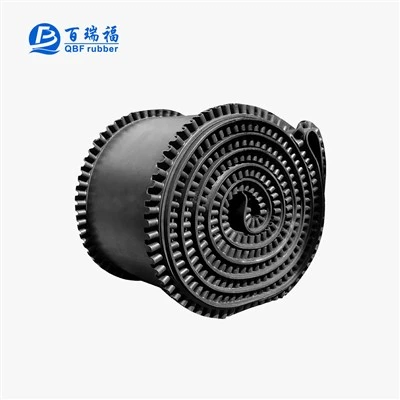
As a supplier of Steel Cord Conveyor Belts, I've witnessed firsthand the transformative impact of multi-flight design on extending the conveying distance. In this blog, I'll delve into the science behind how this innovative approach enhances the performance of steel cord conveyor belts, enabling them to cover greater distances more efficiently.
Understanding Steel Cord Conveyor Belts
Before we explore the multi-flight design, it's essential to understand the basics of steel cord conveyor belts. These belts are renowned for their high strength, durability, and resistance to wear and tear. They are commonly used in industries such as mining, cement, and power generation, where heavy loads need to be transported over long distances.


The steel cords embedded within the belt provide the necessary tensile strength to withstand the forces exerted during operation. This allows the belt to carry heavy loads without stretching or breaking, ensuring reliable and efficient material handling.
The Challenge of Long-Distance Conveying
Conveying materials over long distances presents several challenges. One of the primary issues is the tension required to move the belt. As the conveying distance increases, so does the tension needed to overcome friction and maintain the belt's speed. This can lead to increased energy consumption, belt wear, and the risk of belt failure.
Another challenge is the sagging of the belt between support rollers. Over long distances, the belt can sag under its own weight and the weight of the material it's carrying, causing uneven wear and reducing the belt's efficiency.
How Multi-Flight Design Addresses These Challenges
The multi-flight design offers a solution to these challenges by dividing the conveying distance into multiple sections or "flights." Each flight is equipped with its own drive unit, which allows for independent control of the belt's tension and speed.
Reducing Tension Requirements
By dividing the conveying distance into smaller flights, the tension required to move the belt is significantly reduced. Each drive unit only needs to generate enough tension to move the belt within its respective flight, rather than the entire length of the conveyor. This results in lower energy consumption and less stress on the belt, extending its lifespan.
Minimizing Belt Sag
The multi-flight design also helps to minimize belt sag. By providing additional support at regular intervals, the belt is less likely to sag between support rollers. This ensures a more even distribution of the load and reduces the risk of uneven wear, improving the belt's overall performance.
Improving Flexibility and Adaptability
Another advantage of the multi-flight design is its flexibility and adaptability. It allows for easy modification and expansion of the conveyor system. Additional flights can be added or removed as needed to accommodate changes in the conveying distance or the type of material being transported.
Real-World Applications
The multi-flight design has been successfully implemented in various industries around the world. In the mining industry, for example, it's used to transport coal, ore, and other minerals over long distances. The ability to reduce tension requirements and minimize belt sag makes it an ideal solution for the harsh conditions and heavy loads typically encountered in mining operations.
In the cement industry, the multi-flight design is used to convey raw materials and finished products between different stages of the production process. Its flexibility and adaptability allow for easy integration with existing production lines, improving efficiency and reducing downtime.
Related Products
As a supplier of Steel Cord Conveyor Belts, we offer a range of products designed to meet the specific needs of different industries. Our Steel Cord Belt is a high-quality solution for general-purpose conveying applications. It features a strong steel cord structure and a durable rubber cover, providing excellent resistance to abrasion and impact.
For mining applications, we recommend our Mining Steel Cord Belt. This belt is specifically designed to withstand the harsh conditions and heavy loads typically encountered in mining operations. It has a high tensile strength and a special rubber compound that offers excellent resistance to cutting, tearing, and wear.
In addition, we also offer an Oil Resistant Conveyor Belt for applications where the belt may come into contact with oil or other petroleum-based products. This belt is made with a special rubber compound that provides excellent resistance to oil and chemicals, ensuring long-lasting performance in challenging environments.
Conclusion
The multi-flight design is a game-changer in the world of steel cord conveyor belts. By reducing tension requirements, minimizing belt sag, and improving flexibility and adaptability, it enables these belts to cover greater distances more efficiently. As a supplier of Steel Cord Conveyor Belts, we are committed to providing our customers with the latest technologies and solutions to meet their specific needs.
If you're interested in learning more about our products or how the multi-flight design can benefit your operation, please don't hesitate to contact us. We'd be happy to discuss your requirements and provide you with a customized solution.
References
- [1] Conveyor Belt Handbook, Published by The Conveyor Equipment Manufacturers Association (CEMA)
- [2] "Advances in Conveyor Belt Technology," Journal of Material Handling and Logistics
- [3] "The Impact of Multi-Flight Design on Conveyor Belt Performance," Proceedings of the International Conference on Mining and Materials Handling